I wrote Mr. Biden an email today. Yesterday, he announced that he was not going to seek re-election, and gave his support to VP Kamala Harris.
I don’t feel like I can fully express just how terrified I have been, and so many others have been, during the Trump years, and *are now* with the prospect of more Trumpian rule. I’ll not get into all that as there are plenty of pundits out there. For now, I just want to share what I wrote as a public expression of my gratitude.
Dear Mr. President – I want to express my heartfelt gratitude for all you have done for our country. Your leadership has been unequaled in my lifetime – indeed during the lifetimes of most Americans. You have shown, both in words and in deeds, what it looks like to be a true patriot: strength, compassion, courage, collaboration, commitment, and humility.
I cannot imagine how difficult the situation has been for you, your family, and your administration during the past years. Your steady hand has provided desperately needed stability – both at home here in the U.S. and abroad. Indeed, our country is so much the better for your service: The policies you and your team have brought to life serve all Americans. I know my friends in other countries breathed a collective sigh of relief once you took office.
Thank you for reminding me, and reminding us, of what America is, and should continue to be – a nation that leads, that is strong, that takes care of all of its people, that works with others to secure freedom, opportunity and peace around the world.
My parting hope is that you will realize that you are the face of true leadership and dignity, and that you will know how much you are appreciated. And finally, that this torch that you are passing will burn ever brightly in the hands of such capable people as you have by your side and in your cabinet.
With deepest sincerity, your fellow American Steve Mahaley
She was a pioneer. What do we mean by ‘pioneer’? A pioneer is a person that is brave. A pioneer is a person who is curious and driven. A pioneer is a person who gets things done. A person who readily gives up convention for discovery of something new. A pioneer has courage, stamina, grit. A pioneer is willing to go it alone, but makes way for others.
Mom was a pioneer.
She saw no boundaries to what she could do, her fierce independence stemming from a childhood that, while guided by a loving mother, was punctuated by the sudden death of her father.
But in the way that life provides us with cycles and parallels, she was to meet a young man who shared that pain, having lost his own mother when he was just a boy. That young man would become her husband, and together they would have 5 children.
Life in Mom’s household – for it was hers more than anyone’s – was an experience of continued guidance and sometimes forced learning: how to sew buttons on shirts; how to make a salad; how to hoe a row; how to identify plants and animals; how to grind wheat; and the many potential uses of a wooden kitchen spoon.
We all grew up in her light, occasionally bearing the brunt of her sly humor as she rousted us from bed in the early hours of an early April day to ‘come quick! There’s a cow in the back yard!’. As we all clamored to be the first to the window – peering out in anticipation of such an outlandish sight – mom giggled to herself and then more loudly as we turned, realizing that it was in fact April 1st.
Brave, curious, driven. A pioneer, Mom became curious about the skies and saw no reason why she shouldn’t be able to fly an airplane up into it. As a member of the Petticoat Pilots in North Carolina, she trained and flew a rented Cessna 152 out of the then regional airport called Raleigh Durham. I have memories of being inside that tin can with an engine and wing as mom called for clearance…. Taxiing… taking off… bouncing into the blue.
Self-sufficiency, a hallmark of pioneers – Mom engrained that value and expectation in all of us. Why pay for something you could just as easily – perhaps even more easily and certainly more cheaply – do for yourself? Among the many many examples –
Sewing our clothes
Making rugs out of our worn clothes
Grinding wheat at home to make our own bread
Driving to the local dairy to get the milk ‘first hand’
Getting chickens to have our own eggs
Canning and freezing things we grew, or bought from local farmers
Taking a class, buying the tools, and becoming the mechanic to our family car
Taking another class (MUCH later in life) and learning how to repair small engines so she could keep her weedeater going
Taking a class and then ordering a full-sized loom (for those rugs she was going to make)
Mom served for many years as a camp host up at Balsam Mountain, and for some years would appear at the local visitor’s center dressed in period farmer / pioneer dress – demonstrating the early ways of invention, production, self-sufficiency and survival…
And, in the tragic way that life can deal us devastating parallels – much as she lost her father just as a child, she lost her husband just as they were beginning a golden chapter of togetherness. Robbed. Cheated by illness that took her life partner from her, just as she finally got time with him.
So, she started over and built a solo life for herself, especially after her own mother’s passing, connecting to and relying on that inner curiosity, drive, and disregard for convention. She heated with wood, kept her favorite cat in good health, locked the hubs and chained the tires in winters, and stayed on the mountain she and her life partner chose together. Perhaps strengthened by her early experience with loss, but certainly lifted up by her children and friends – she succeeded – receiving multiple recognitions and awards for her service as a park volunteer, and becoming more and more of a grandmother as we all brought new kids into the world.
She went it alone for much of this time; but made way for all of us.
A pioneer – with courage, stamina and grit.
And now. The fuel for her stamina finally spent, she has left this earth, making as one of her wishes a gift of her own body to science, so that others may learn – she is *still* teaching us – and so that others may not know the struggle of the inner loss she has experienced over the past few years.
The love we all have for her is immeasurable, and now it is up to us to determine, for ourselves, perhaps even risking convention, what new challenge we will set for ourselves. What new skies we will fly into. And how we too may be pioneers, like our amazing mother.
As I’ve posted earlier, questioning whether rising tides do, in fact, lift all boats, I find this article by a couple of South African academics to be compelling. We really must think critically about the narratives and ideological frames that are espoused in the halls of leadership and management thinking – and look more aspirationally at what innovations can (and should) mean for ALL people.
The Fourth Industrial Revolution: a seductive idea requiring critical engagement
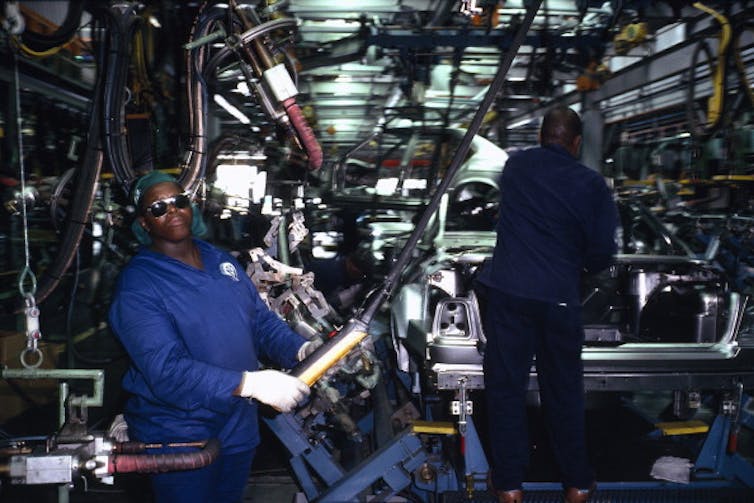
Technological innovation can indeed be beneficial for the working class. Photo by JNS/Gamma-Rapho via Getty Images
Narrative frames are fundamental to unifying ideologies. They frame what is possible and impossible, which ideas can be accepted and which must be rejected. In her book, Digital Democracy, Analogue Politics, storyteller and political analyst Nanjala Nyabola examines the framing of the Fourth Industrial Revolution narrative in this light.
She argues that it is being used by global elites to deflect from the drivers of inequality and enable ongoing processes of expropriation, exploitation and exclusion. During a recent policy dialogue on the Future of Work(ers) she commented:
The real seduction of this idea is that it’s apolitical. We can talk about development and progress, without having to grapple with power.
The Fourth Industrial Revolution’s chief ideologue is Karl Schwab, chair of the World Economic Forum who published an influential book by the same name. In it he argues that digital innovations are transforming the ways in which people live, work and relate to one other. These include artificial intelligence and robotics, quantum cloud computing and block chain technology.
Compared to previous industrial revolutions, he maintains, the Fourth Industrial Revolution is evolving at an exponential pace, reorganising systems of production, management and governance in unprecedented ways.
But there is growing critique, particularly from the global South, of this capital-friendly framing of the Fourth Industrial Revolution. Many are questioning whether it should be considered a revolution at all.
The available evidence suggests that the proliferation of digital technologies has been highly uneven, driven by an older generation of technological innovation, and used to reproduce rather than transform unequal social relations.
We share the view that there is nothing predetermined or linear about what digital technology is developed, how it is used, and for what end. The challenge is how to harness digital innovations to improve the conditions of work and life, while holding capital accountable.
Arguments against
Historian Ian Moll questions whether the current myriad of digital technological innovations constitute an industrial revolution. After all, revolutions are not characterised by technological changes alone. Rather they’re driven by transformations in the labour process, fundamental changes in workplace relations, shifts in social relations and global socioeconomic restructuring.
The industrial revolution, for example, gave rise to factories that changed how people worked as well as where they lived. The centralisation of workplaces saw growing urbanisation, deepening class divides between the rich and the poor. It also saw the emergence of trade unions.
It is clear that digital technologies are reshaping the structure of the labour market and conditions of work. They are doing this through automation and labour replacement, the informalisation or Uberization of work, the imposition of algorithmic management and commodification of data.
But they seem to be deepening rather than transforming historic patterns of inequality along the lines of class, gender, race, citizenship and geographic location.
As Nyabola put it:
Data is the new oil … data points which can be extracted for profit.
Despite critiques, the African Union (AU) has embraced the Fourth Industrial Revolution as a “watershed moment for Africa’s development”. The AU describes it as an opportunity to leapfrog into the digital era, increase global competitiveness and generate new sources of employment.
Scholar-activist Trevor Ngwane argues in the edited volume, the Fourth Industrial Revolution: a Sociological Critique, that technological innovation can indeed be beneficial for the working class. It can reduce drudgery, improve working conditions and free up more time for people to engage in other meaningful activities.
The problem is that the fruits of technological innovation are being monopolised by a globalised capitalist class. Take the example of digital labour platforms. Financed primarily by venture capital funds in the global North, they have set up businesses in the global South without investing in assets, hiring employees or paying into state coffers.
This process is being buttressed by a framing that portrays the current terms of innovation as inevitable and thus uncontestable.
We can allow capital to do what it wants. Or we can start imagining a world where we set the parameters for what tech should be.
Dooms agrees that the narrative of the Fourth Industrial Revolution is more aspiration than reality. But it’s precisely because it is aspirational that its terms can be shaped. What is the place of Africans in an increasingly digitised world? How are technologies affecting people’s lives, identities and access to opportunities? How can innovations advance a more just society, where people are freed up to do meaningful work? How can states use regulations and other means to ensure the benefits of technological innovation are more equally shared?
The Future of Work(ers) Research Group at the Southern Centre for Inequality Studies at the University of the Witwatersrand is hosting a six-part dialogue series. The aim is to generate further debate on the relationship between digital technologies, the changing nature of work(ers) and the implications for inequality.
Seipati Mokhema, an Associate Researcher with the Future of Work(ers), contributed to this article.


 Fresh Eyes