

THE CANADIAN PRESS/Graeme Roy
Dr. Javeed Sukhera, Western University
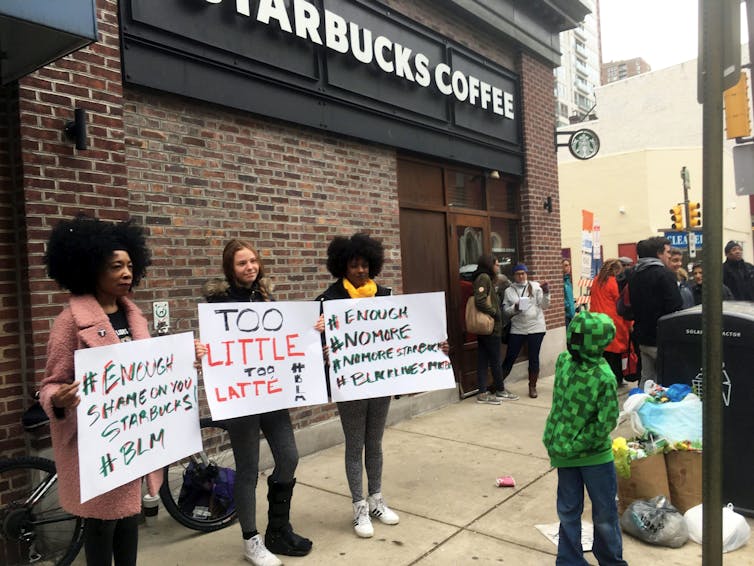
On Tuesday, Starbucks stores in the United States will close for part of the day to deliver “implicit bias training” for all of its employees. Canadian Starbucks employees will get similar training June 11.
Whether you have heard of implicit or unconscious biases through Starbucks’ recent controversy or as a topic in the 2016 U.S. presidential debates, the topic of implicit bias seems like it is everywhere.
We are all familiar with the concept of explicit biases. These include attitudes and behaviours regarding certain groups with the intent to harm or exclude. Explicit biases can be obvious, such as racism or believing one ethnic group is superior to another. They can also be subtler, like favouring someone we know.
These explicit biases are conscious, intentional and deliberate.
In contrast, implicit biases are stereotypes that form through our experiences and that work outside of our awareness. Even though we are not aware of them, implicit biases lead to discriminatory behaviours and biased decisions.
Implicit biases can also include non-verbal behaviours or avoidance. By their very nature, implicit biases are automatic beliefs or associated behaviours that influence us without our knowledge and despite our best intentions.
Implicit bias is harmful
Starbucks’ baristas are not the only workers who demonstrate implicit bias.
When individuals with “Black-sounding names” applied for jobs compared to individuals with “white-sounding names,” the people with white names received 50 per cent more callbacks. In another study, psychologists who were applying for jobs found that out of two identical CVs, one would be rated more positively if it was attached to the name Brian compared to the name Karen.
Research on implicit bias in health care has demonstrated how health professionals can make biased clinical decisions, even when their intentions are to treat all groups fairly.
For example, an important study by doctor Alexander Green and his colleagues in 2007 found that despite explicitly denying a preference for white versus Black patients, doctors implicitly saw Black patients as less co-operative regarding medical procedures. Those doctors who demonstrated increased levels of implicit biases were more likely to treat their white patients over treating Black patients for their heart attacks.
Similar research has found that implicit biases contribute to racial disparities in pain treatment and adversely influence several patient populations.
Read more:
Racism impacts your health
We also know that implicit biases lead to behaviour that undermines trust. Groups that experience discrimination experience a profound negative effect which leads to self-reinforcing cycles of distancing and disconnection.
Individuals who encounter implicit biases can gradually internalize them and this leads members of certain marginalized groups to begin to conform to negative biases about themselves.
Bias training for all?
So should we all follow Starbucks’ lead and implement implicit bias training in our organizations?
(AP Photo/Ron Todt)
While implicit bias is a problem that erodes equity and perpetuates discrimination, research on implicit bias training highlights mixed results and suggests that implicit bias training alone will not solve the problem.
My research on implicit bias in health professions sought to understand how this training works. Early in our journey, we learned that simply making individuals aware of their implicit biases was not enough.
When our participants became aware of their biases through an online metric of implicit bias called the implicit association test (IAT), developed by researchers at Harvard, it led to significant emotional distress and a defensive reaction.
A hard look in the mirror can hurt
We were surprised to find that when we provided people with feedback about their implicit biases, this information was inconsistent with an idealized version of themselves that was simply impossible to achieve.
Societal pressures and stigma against being prejudiced led to individuals feeling like they are not allowed to have any bias, despite the fact that we all have biases, and not all biases can be eliminated. In fact, some biases may be helpful to keep us safe.
Implicit bias training is therefore unique from other forms of diversity training because a conversation on implicit bias must start with a hard look in the mirror. The conversation can only begin once we humble ourselves by recognizing that we are all deeply flawed and imperfect human beings.
Training can be most effective when there is a balance between psychological safety and motivation to change behaviour.
Knowing and reflecting
Simply knowing about our biases is not enough. Once we become aware of our own biases, we must reflect on how these biases impact ourselves and others.
Discussion and dialogue are both important to reflect on how certain biases may be negative or positive and useful or counterproductive, depending on context. Then, we must begin to set and practise tangible changes in our explicit behaviours.

Shutterstock
For example, our research found that physicians and nurses often have implicit biases towards individuals with mental illness who come into emergency departments because these health professionals label such patients as “unfixable,” and implicitly avoid them because they do not feel like they can offer their patients any assistance.
The patients, however, perceived this implicit avoidance as prejudice and discrimination. Our initial training highlighted these biases for doctors and nurses but also promoted explicitly and intentionally engaging with such patients to counter the tendency to avoid them.
We also learned that accomplishing change requires dialogue to reconcile our biases and open conversations with our peers can help motivate us to change behaviour.
Learning together
Interventions to reduce the adverse impact of bias are most effective when people who work together learn together, and when teams feel comfortable being open about their biases with one another.
Our training was most effective when it was accompanied with constant discussion and dialogue among people who work together. Individuals who participated in the training began questioning biased practices and demonstrating new behaviours which provided a model for others in the workplace to emulate.
Another challenge with implementing bias training is that biases and inequities often become embedded in workplace structures and policies over time. In our most recently published paper, we followed participants for 12 months after they participated in implicit bias training.
Initially, these participants told us that they enjoyed learning about their biases and wanted to change, but any change they promoted went up against a workplace culture that was a barrier to change.
As we followed them over time, participants began reflecting on their biases and engaging in explicit behavioural changes that influenced the perception of structural changes within the learning environment itself. Together, our participants began co-constructing social change.
This finding is important because addressing implicit bias cannot be achieved by individuals alone. Explicit structural and organizational changes are also required to promote change.
If we encourage individuals to question biased norms within their workplace but they speak up and face retribution for doing so, we are creating more problems than we are solving. If any company wants implicit bias training to be successful, the company itself must survey its policies and processes and be prepared to change them.
 If your company decides to implement implicit bias training, make sure you ask them what else they plan on doing to promote equity and reduce discrimination. Shutting stores or implementing mandatory training will simply not be enough.
Dr. Javeed Sukhera, Assistant Professor, Schulich School of Medicine and Dentistry, Department of Psychiatry, Western University
This article was originally published on The Conversation. Read the original article.


 In
In  Fresh Eyes