Education for Effect

Having been in the business of executive and management development for 18 years, I’m quite familiar with the questions clients have about return on investment (ROI).   We routinely include positioning on this in our work proposals, and follow through with components of program design that are explicitly intended to answer that question.  While some program outcomes can be readily measured, others take more time to see impact – so there is a range of applications that can and should be brought to bear as education service providers do their work.

Fundamentally, however, there is often a mindset shift that is required of education service providers.  It is all too easy to fall into the trap of focusing on the event of education, and not on the impact it should have.  Think about how many resources are wrapped up in answering questions about the who, when, what, where and how of education.   Event planners, internal learning and development staff, assessment experts, systems engineers and support staff – all focused (and rightly so) on the delivery of the education.  But what about the ‘why’ of the intervention?

Mindsets need to change about why we, as learning and development leaders and providers, are here.  We are not here to provide learning events alone.  We are here to drive successful, behavioral impact in the business to improve business performance, on whatever metrics have driven the need for learning in the first place.  This has a few critical implications:

  • Often, different conversations with different stakeholders are needed.   You really need to be asking the question:  “As a result of this learning and development initiative, what organizational performance effect are you hoping to realize?”  That may mean that you need to talk to business leaders, and help forge or strengthen the alignment between the L&D function and the line.
  • Your designs, however beautiful and compelling, will be insufficient as long as they do not incorporate the insights from answering the question above.  No learning intervention design should leave the shop without a clear articulation of how you are going to assess the impact of the learning at the organizational level.

These can be tough conversations, especially in ‘hardened’ organizations where traditional educational models reign and budgets and infrastructure are relatively secure.  It can, in fact, be quite threatening to put your reputation on the line, as a learning and development professional, by putting real business impact metrics in place.  However, this is our responsibility – to do anything less would be a disservice.   And, with the many options we have available to us for ensuring that there is accountability, support and process to favor effective application of learning at work, we really don’t have any excuse.

Further good resources here:  Arun’s work at Design4Performance; Conrad and Bob’s 2012 article on the 5 moments of learning need.
Posted in Education | Leave a comment

Towards a Pedagogy of Technology, 2

Next installment in this mini-series.  This one is about critically assessing the pedagogical utility of the technology at hand.

Claim 2:  Every tool has its purpose.  Or purposes.

Effectively – every tool has its purpose.  Some can serve more than one, from a pedagogical standpoint.  Thankfully, some good work has been done on this front:  The SAMR model (thank you, Dr. Ruben Puentedura) gives us a framework for thinking about whether the tech at hand is a

  • Substitute – for some existing method or practice.  Think about how polling platforms on mobiles provide a replacement for hand distributing polling questions, or just counting physical hands.
  • Augmentation – enhancing a particular method or practice.  The same example above can be applied here.  New polling tech doesn’t require people to be in the same physical location.  Polling is now ‘augmented’ to reach beyond a physical classroom.
  • Modification – significantly changing the method.  So, think about using shared Google docs to compose a paper.  The rapid collaborative nature of that approach to composition is significantly different than doing hard-copy edits / reviews.
  • Redefinition – my personal favorite:  tech that allows us to do things that were previously undoable.  Think about digital geo-location scavenger hunts.

More recently, that model informs a display created by Allan Carrington that captures a vast array of modern tech, and classifies them along the SAMR categories.  Click here for a PDF of that.  Carrington has done the yeoman’s task of combining a list of modern tech, aligning those with the SAMR framework, detailing what activities these apps and technologies allow, and also what action verbs (think Bloom’s Taxonomy) are implied in these.

For those of us in the adult education arena, we must, must, MUST not fall into the all-too-common trap of recreating bad pedagogy in new technology.  For example, some years back, a tragic thing occurred when a brand new and amazing technology – 3D, avatar-based environments – came into being.  Universities and institutions around the world leapt into action, and nearly every one that I visited (either in Second Life, or in Protosphere, or others) set as their first task to replicate the very buildings of their campuses, complete with tight classrooms with fixed chairs…. in rows…. facing a wall where, guess what, some version of PowerPoint could be displayed.

I nearly cried.

Posted in Education, Technology | Leave a comment

Towards a Pedagogy of Technology

This is the first in a series of ideas I’d like to share about how to position technology tools in the design and delivery of education.

Four claims for better learning design:

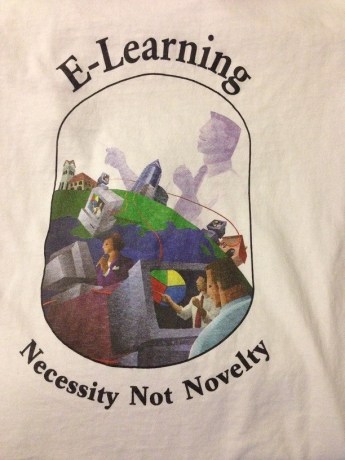
Claim 1: There is an ‘e’ in learning.  It is time for us to move beyond the 1990’s interpretation of technology-mediated learning design.  We still say ‘e-learning’ and that implies often (unfortunately, and understandably) a sub-standard and lonely learning experience – picture the poor soul subjected to hours of ‘click-and-learn’ under the buzzing fluorescent light of the after-hours office.

E-Learning t-shirt 2001

A t-shirt from 2001 from a very recognizable high-tech firm (who shall remain nameless).

Here’s a simple way of thinking about it: There is an ‘e’ in learning.  You may think it trite, but my contention is that as long as we continue to differentiate what is ‘electronic’ from whatever the rest of the learning is, we will continue to constrain our thinking and handicap our designs.  It is our opportunity, as learning designers, to prove this to the world.

Fortunately, that should be easy with more brainpower devoted to appropriately innovative (attention, here, as innovation needs to follow learner context rather than lead with shiny tech) uses of new technologies, the extensions of learning outside the classroom (as referenced in 70, 20, 10) and care in how we develop the designers in our businesses and our network of education providers to operate in these models.

This calls upon us to go beyond content production and to deeply examine the range of tools available to the learner participants, and assess their pedagogical value.

More on that later.

Posted in Education, Technology | Leave a comment