
-
Archives
- March 2026
- February 2026
- January 2026
- December 2025
- November 2025
- September 2025
- August 2025
- July 2025
- June 2025
- May 2025
- April 2025
- March 2025
- February 2025
- January 2025
- December 2024
- November 2024
- July 2024
- October 2022
- June 2022
- April 2022
- July 2019
- January 2019
- September 2018
- July 2018
- June 2018
- May 2018
- April 2018
- January 2017
- December 2016
- November 2016
- September 2016
- July 2016
- June 2016
- March 2016
- September 2015
- February 2015
- February 2012
- November 2011
- October 2011
- September 2011
- May 2011
- January 2011
- December 2010
- November 2010
- October 2010
- September 2010
- August 2010
-
Meta
It’s not whether, it’s how.
Racism.
It creeps into so many conversations and those perpetrating racist ideology (yes, I’ll call it that) don’t even realize it. It’s the ethical equivalent of unconscious incompetence when it comes to awareness of one’s own prejudices when it comes to races.
Don’t believe that you are a racist? Great. I invite all my friends and those I don’t know to do a painfully honest bit of reflection on the example below, and ask yourself – do I ever do this?
In a conversation amongst a set of well-to-do white folk, stories of robberies were shared. One participant in the conversation shared a story of being robbed in a fast food restaurant. Here’s the catch: at one point, the raconteur shares that “well, it was a black guy”. And that he went after him.
Now stop.
What should we infer from that small little verbal ‘tell’ (as if playing poker)? Are we supposed to be more afraid? Less afraid of the thief? Are we to assume that it all makes sense now that race has been clarified? Are we to think our raconteur even more brave as he tells his story of chasing the thief down?
I’m sure that my teller would refute the possibility of being racist, if challenged. That’s because racism is some distant concept that I believe is still equated with open slavery, unequal rights, separate water fountains, etc. No, the much more insidious and ever-present racism is that which reveals itself in these small verbal gestures in conversation.
The fact that the thief was black had NOTHING to do with the story, other than to propagate an idea that black guys are somehow more frightening and dangerous than any other dudes. Don’t think this has an effect? Just do a little research into how racial bias plays itself out in new hire selection, promotion, police action, loan granting, grading patterns in education, the list goes on and on.
Don’t get me wrong. I don’t think the speaker was intentionally trying to propagate a negative racial stereotype. I fully believe he is unconsciously incompetent. That’s as charitable as I can be.
By the way the real problem is poverty – lack of education and opportunity. Let’s solve those, and perhaps we’ll be on our way to reducing crime.
It’s not a question of whether we are racist, but just how we are racist.
And yes, I too have an ongoing conversation with myself about this, having grown up white and privileged in the US. I am on a journey to minimizing (hopefully eradicating) my racist beliefs and actions. I am proud to have a very diverse set of friends – people I admire, respect and love – who are of all varieties.
Keep me honest, guys and gals.
Connecting Social Media to Learning
I’m confused.
I hear the term ‘social media’ being used as a place holder for new hardware (tablets, smartphones, iPods, etc.) AND for content that is accessible through new hardware or web distribution mechanisms, AND for software people are using (Twitter, Facebook, etc.) AND for the particular behaviors that people are engaging in.
I’m trying to simplify my life a bit. Communication of ideas demands that we define things together, or at least attempt to do so, so that we can know what we are talking about. And I’m thinking about the link between social media and learning. So. I’d like to propose the following:
Social media is a changing set of tools that provide channels through which people can connect, create, share and interact.
Too often I hear and see people approaching this from a publishing standpoint. “Oh wow, we can now push our content out through social media!”
Please don’t.
Or at least consider the ‘social’ part of social media. This is about people connecting to people way before anything to do with content. We are social creatures. Social media tools have simply provided a vast new (and changing) array of methods by which we can be what we are – humans.
- Social media behaviors arise from the proliferation and availability of the tools, and our natural inclination to connect with others.
- Social media tools continue to change. Beware he or she who claims to be an expert in a field of such shifting sands.
- Social media tools are primarily software. Your smartphone is a dumb paperweight without the software on it.
(steps down from soapbox)
The link to learning.
The use of social media tools (such as Twitter, Facebook, YouTube, etc.) does not necessarily connote ‘development’ or ‘learning’ of course. I don’t doubt that we are learning things through social media tools (thank you, FB friends for sharing your insights on living in London!), but the question for me is how to wisely use social media tools in a designed learning experience.
It strikes me that, as some have identified, there are hundreds of social media tools, and that each of them may present the education designer with unique opportunities. It’s like suddenly discovering your spice cabinet when you’ve been cooking with salt and pepper only. (note to self. must buy spices)
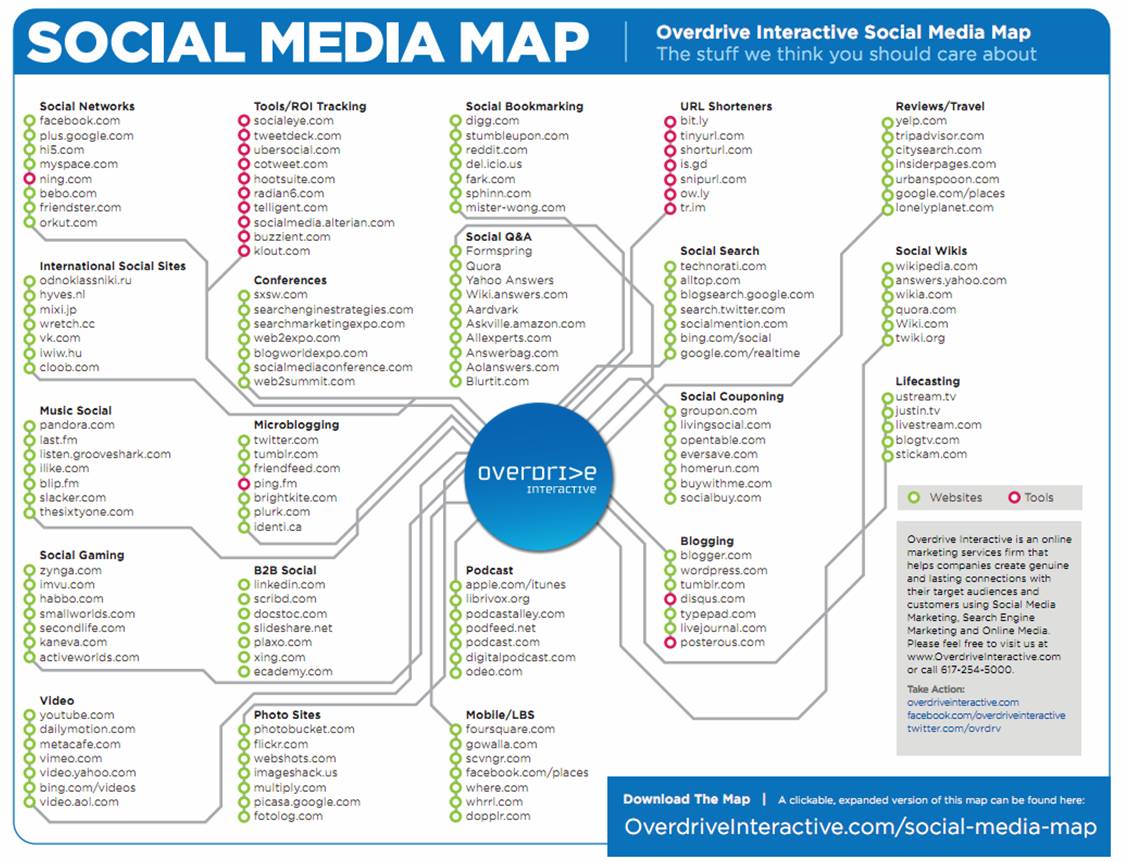
Overdrive Interactive's map of social media tools
Here are just a couple of ways I’m thinking about the tools:
- Access to published material for commenting (YouTube, Flickr, etc.)
- Collaboration and co-creation (Wikis, Google docs, etc.)
- Quick sharing of info in a broadcast or narrowcast approach (Twitter, Facebook)
- Aggregators of feeds and other tools (Facebook, LinkedIn, etc.)
- Immersion for shared experience (virtual worlds, gaming spaces)
The above is imperfect and incomplete. As education designers, we need to think pedagogy first, then examine what each of these new tools can do, and (importantly) take a constructivist view – put the tools in the hands of the learners. Give them a goal that is meaningful. Provide guidance and source materials. Step aside. Let them be humans and actively connect with each other to build and create meaning, practice new behaviors, get feedback, and have access to support.
I think that the constellation of social media tools provides a new array of possibilities regarding how an individual accesses networks of information and people that are important to her or him, how they interact and make meaning of new information socially with others, and therefore how they gain insight and translate that into effective behaviors for work and personal contexts.
 Fresh Eyes