Connecting Social Media to Learning

I’m confused.

I hear the term ‘social media’ being used as a place holder for new hardware (tablets, smartphones, iPods, etc.) AND for content that is accessible through new hardware or web distribution mechanisms, AND for software people are using (Twitter, Facebook, etc.) AND for the particular behaviors that people are engaging in.

I’m trying to simplify my life a bit.  Communication of ideas demands that we define things together, or at least attempt to do so, so that we can know what we are talking about.  And I’m thinking about the link between social media and learning.  So.  I’d like to propose the following:

Social media is a changing set of tools that provide channels through which people can connect, create, share and interact. 

Too often I hear and see people approaching this from a publishing standpoint.  “Oh wow, we can now push our content out through social media!”

Please don’t.

Or at least consider the ‘social’ part of social media.  This is about people connecting to people way before anything to do with content.  We are social creatures.  Social media tools have simply provided a vast new (and changing) array of methods by which we can be what we are – humans.

  • Social media behaviors arise from the proliferation and availability of the tools, and our natural inclination to connect with others.
  • Social media tools continue to change.  Beware he or she who claims to be an expert in a field of such shifting sands.
  • Social media tools are primarily software.  Your smartphone is a dumb paperweight without the software on it.

(steps down from soapbox)

The link to learning.

The use of social media tools (such as Twitter, Facebook, YouTube, etc.) does not necessarily connote ‘development’ or ‘learning’ of course.  I don’t doubt that we are learning things through social media tools (thank you, FB friends for sharing your insights on living in London!), but the question for me is how to wisely use social media tools in a designed learning experience.

It strikes me that, as some have identified, there are hundreds of social media tools, and that each of them may present the education designer with unique opportunities.  It’s like suddenly discovering your spice cabinet when you’ve been cooking with salt and pepper only.  (note to self.  must buy spices)
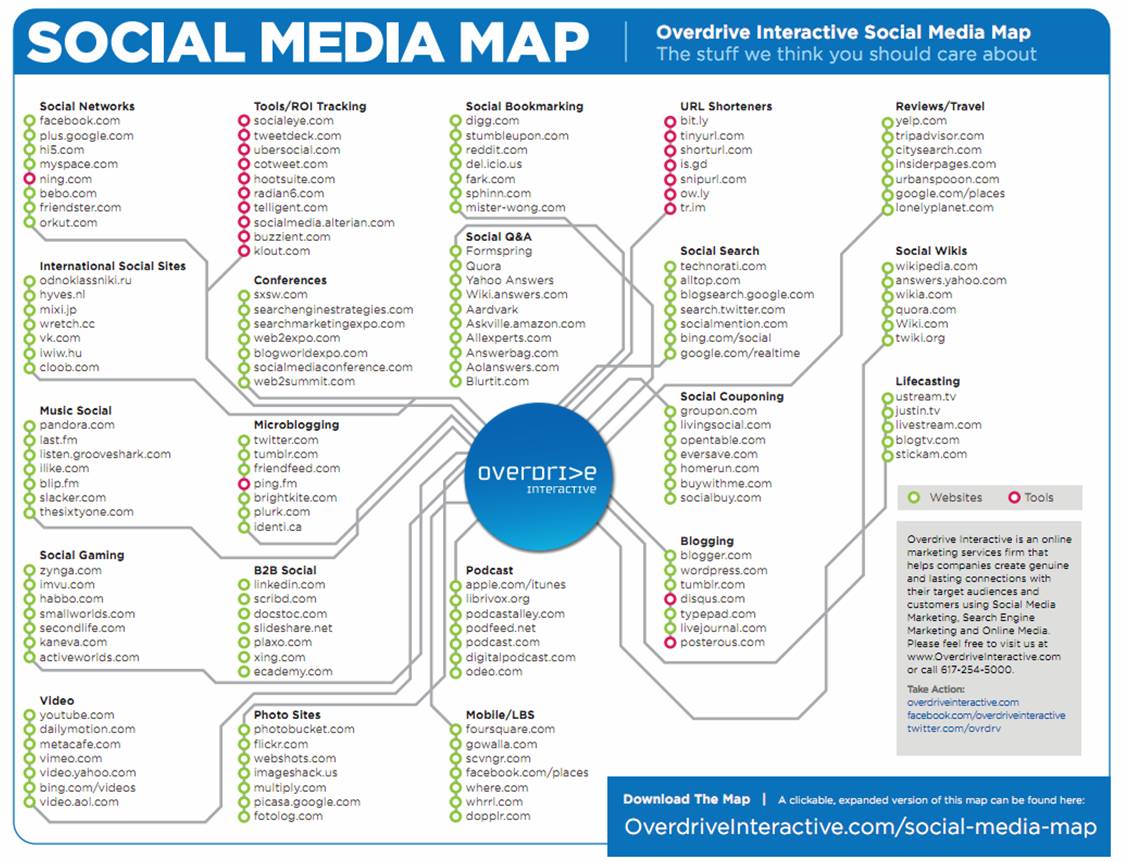
Overdrive Interactive's map of social media tools

Here are just a couple of ways I’m thinking about the tools:

  • Access to published material for commenting (YouTube, Flickr, etc.)
  • Collaboration and co-creation (Wikis, Google docs, etc.)
  • Quick sharing of info in a broadcast or narrowcast approach (Twitter, Facebook)
  • Aggregators of feeds and other tools (Facebook, LinkedIn, etc.)
  • Immersion for shared experience (virtual worlds, gaming spaces)

The above is imperfect and incomplete.  As education designers, we need to think pedagogy first, then examine what each of these new tools can do, and (importantly) take a constructivist view – put the tools in the hands of the learners.  Give them a goal that is meaningful.  Provide guidance and source materials.  Step aside.  Let them be humans and actively connect with each other to build and create meaning, practice new behaviors, get feedback, and have access to support.

I think that the constellation of social media tools provides a new array of possibilities regarding how an individual accesses networks of information and people that are important to her or him, how they interact and make meaning of new information socially with others, and therefore how they gain insight and translate that into effective behaviors for work and personal contexts.

Posted in Education | Tagged , , | Leave a comment

Lucy’s Amaryllis

“Can I help you?”

I asked the lady who I had watched, walking slowly up the sidewalk in front of me.  She was balancing a large bin on her head.  This seemed unusual.  I saw a lot of this in other parts of the world, but not here in London.

She was older, and wearing a navy uniform of sorts, carrying a purse and wearing a backpack in addition to the large bin she had now rested temporarily on a letter box.

It was after 9:00pm on a Friday night.  The rains from earlier in the day left the sidewalk reflective in the streetlights, a carpet of leaves growing here and there as November had arrived.  Guy Fawkes was already being celebrated, as an incongruous moon peered down upon some distant fireworks.

“Oh no, it is quite light.  Can I give you some of this windfall?” she asked with a heavy accent.

In the bin were a a pile of light-colored flowers – large flowers, all bunched together.

“Do you have a lady who would like some of these flowers?”

Still wearing the backpack, she now set the bin down on the ground.  I was fascinated.  I said, “Yes I do, but she is all the way in the United States!”  I thought this might throw her off, but she replied:  “Well then perhaps you have a neighbor, or a sister or someone?  It is a shame to just pitch them out..”

I agreed to take some, and upon doing so, she handed me these tremendous blooms – just one stalk of pale, paper-thin petals.

But that was not all.

“You must have some ivy.  Come, would it trouble you to go just down Victoria Rise?”  I had a moment’s pause, but then said “of course – can I carry the box?”  She again said, no, that it was light.  And she moved deftly across the street to the corner and down the block.  Along a wall she stopped, put the box down, and peered up an overgrown wall that must have been 10 feet high.

“This is it.  Can you see if the leaves will do?  My eyes are not very good.  I have some scissors…”  Remarkably, she produced a pair of scissors, donned a cloudy pair of glasses, and reached up and began rapidly clipping off strands of the cascading  ivy.

Her name was Lucy.  She worked at a local software development office a few blocks away.  She is a part-time guard there.  I asked where she was from.

“Italy.”

I said I had been to Italy.  She asked where.  The first city I could recall, and from my last trip.

Me.  “Milano.”

Lucy.  “That is the only city that I know.”

Me.  “You are from there?”

Lucy. “Just north of there.”

Me.  “I have been to Lago di Como.”

Lucy.  “THAT is where I am from.”

Me.  “WHY would you ever leave THERE?”

Lucy.  “I am surrounded by mountains, the snow in the winters… there is not much to do.”

I graciously accepted the bunch of ivy she handed me.  She put her scissors and glasses away.  Again I offered to help her with her load.  Again she refused.Lucy's Amaryllis

“I will go home now – I live just there – I will go home, and have a cigarette with my neighbor.  It is nice to see a man who would stop to help a woman.”

I did not know what to say.

Goodnight, Lucy.

Posted in Ramblings | Tagged , , , | Leave a comment

Gaming the System

Some think of games as a pass-time, or what you might choose to do when you are not doing anything serious.  In fact, an alternative to the serious stuff we do most of the time.  Yes, we (people, everywhere) play games for fun.  And ‘fun’ is typically not how we might describe our work, and the challenges we face there.

I am reading Jane McGonigal’s Reality is Broken, and encourage anyone interested in the world of online games and what we can learn from them to do so as well.

Jenny Nicholson, creator of Spent, provides us with a gamer’s entry into modern-day poverty.  An excellent article by Al Lewis sheds light on Ms. Nicholson’s story, and how she makes what is often just an intellectual exercise for many of us who are fortunate to have good jobs become a very real and intense situation.

I played the game for a few rounds and found myself zeroing in on my cash balance toward the end of the month, and feeling the dilemma of choices – food?  Car repair?  Day care?  Doctor’s visit?

The most difficult choice many of us make is something on the order of paper or plastic.  Games present us with an opportunity to be immersed in a staged reality – and in this case a reality that many of us on the outside need to experience just a bit.

Thanks, Ms. Nicholson, and give my regards to my colleagues back in Durham at the Duke CE office in the ATC (a few doors down).

Posted in Education | Tagged , , , | 1 Comment